Most plumbing websites are built to look professional.
This one was built to survive, serve, and scale.
Serrano’s Plumbing Services did not build a 356-page website because we wanted a bigger online brochure. We built it because the plumbing industry has been handed over for too long to lead companies, directory sites, and advertising platforms that do not turn wrenches, do not crawl through attics, do not diagnose leaks, and do not stand behind the work inside a customer’s home.
Angi, Yelp, and other lead platforms became the middlemen between homeowners and the actual tradespeople doing the work.
This website was built to change that.
It was built by a plumber, from the ground up, in a small town near Hammond, Louisiana. It was built during six months of long days, late nights, 20-hour work sessions, financial pressure, vehicle problems, and the kind of setbacks that test whether a person really believes in the future they say they are building.
This was not built from comfort.
It was built from commitment.
It was built because a Google Business Profile alone was never going to create enough opportunity to feed a family, grow a company, hire good technicians, and compete against companies that had decades of online authority.
So instead of depending on lead platforms just to show up to a job, Serrano’s built its own digital infrastructure.
Not a directory.
Not a lead farm.
Not a rented marketing channel.
A plumber-owned regional service network.
Chapter 3: Resilience, Infrastructure, and the Road Forward
This is not the first chapter of the Serrano’s story.
We already told the story of Joshua Serrano and the beginning of Serrano’s Plumbing Services. We also told the story of going from a Mustang to a growing plumbing company in Southeast Louisiana.
But that was only part of it.
The next chapter was harder.
During the same season that I was building the website, mapping the service areas, writing the pages, and manually connecting the internal links, I was also trying to keep the business alive in the field.
I was working out of a Mustang because that was what I had.
That Mustang helped me get to jobs, make repairs, serve customers, and stack enough money to buy my first work van. That van was supposed to be the next step. It was supposed to give Serrano’s Plumbing Services the work vehicle it needed to grow.
But two weeks after buying it, the motor failed.
The person who sold it had changed the main bearings on the crankshaft just enough to get the van running well long enough to move it. It held together long enough for me to buy it. Then it went out.
Just like that, I was down again.
No reliable van.
No real work vehicle.
And then the Mustang was gone too.
After moving insurance over to the van, the Mustang ended up getting impounded, leaving me without the same car I had been using to keep the business moving.
I was out of a ride.
But the work still had to get done.
So I caught rides to my last few jobs. I kept showing up. I kept doing the work. I kept serving customers. Those jobs helped me build enough money to buy a second van and keep moving forward.
All of this was happening while I was still building the website.
That is why this is not just an SEO project to me.
It is a test of resilience.
It is a record of commitment.
It is proof that I believed in the future I was building before it was easy to believe in.
I Could See the System Before It Existed
Before the network was built, I could already see how it needed to work.
I could see the services.
I could see the cities.
I could see the regions.
I could see how a customer searching for a water heater problem, drain backup, sewer issue, leak, toilet problem, fixture repair, or emergency plumbing call needed a clear path to the right page.
That is why I could not build this like a normal plumbing website.
I understand systems.
Plumbing is systems. A home is a system. Water lines, sewer lines, vents, fixtures, shutoffs, water heaters, drains, and cleanouts all connect. If one part is ignored, the rest of the system can suffer.
I looked at the website the same way.
I did not want disconnected pages. I wanted structure. I wanted flow. I wanted every page to have a purpose, every service to have a place, and every city to connect into the larger network.
The blueprint was in my head before the site was finished.
Then I built it by hand.
Why This Had to Be Built
The old model is broken.
A homeowner searches for a plumber. Instead of finding the actual company that will show up, they often land on a directory, a review platform, or a lead-selling website. Their information gets captured, sold, routed, or recycled. The plumber pays for the chance to compete for the same customer everyone else is chasing.
That cost gets built into the business.
When a plumbing company depends too heavily on paid leads, the money has to come from somewhere. It comes out of margins. It comes out of growth. It comes out of technician pay. It comes out of the ability to build a better company.
Serrano’s Plumbing Services is being built differently.
The goal is to become one of the highest-paying plumbing companies in the markets we serve. That is only possible if the company owns its own lead flow, owns its own digital infrastructure, and does not have to keep handing money to platforms just to reach customers.
I understand what it takes to be a plumber.
I understand what it feels like to work in the heat, carry the tools, crawl under houses, sweat in attics, diagnose problems, and stand behind the job.
Because I understand that, I know plumbers deserve to be paid well.
The money should go to the people doing the work.
Not to platforms that never touch the tools.
This website is part of that plan.
It is not just SEO.
It is independence.
Built to Help Homeowners, Not Just Sell to Them
This network was not built only to sell plumbing jobs.
It was built to help homeowners.
That matters to me because every service call is not just a transaction. Behind every call is a family, a home, a budget, a problem, and a decision that needs to be made the right way.
Some customers need an emergency repair. Some need help understanding whether a water heater should be repaired or replaced. Some need to know if a leak is coming from a water line, a sewer line, a fixture, or a water heater. Some need honest guidance before the problem gets worse.
That is why Serrano’s Plumbing Services is built around education, inspection, and options.
When we show up, the goal is not just to sell something. The goal is to understand the home, find the problem, explain what is going on, and give the customer a clear path forward.
That is also why I believe in performing a 25-point inspection on service calls.
A plumbing problem rarely exists in a vacuum. A leaking water heater may expose old shutoff valves, unsafe piping, missing protection, or other issues that a homeowner deserves to know about. A clogged drain may point to a deeper sewer issue. A fixture repair may reveal worn stops, old supply lines, or water damage risk.
Customers deserve more than a quick patch with no explanation.
They deserve to know what we see.
They deserve options.
They deserve honesty.
They deserve a plumbing company that is trying to take care of the home, not just close a ticket.
That same belief is built into the website.
Every service page, city page, regional hub, blog post, and internal link was designed to help customers understand where to go, what service they may need, and how Serrano’s Plumbing Services can help.
Why I Could Not Leave the Vision in Someone Else’s Hands
I had marketing companies call me.
I had people try to sell me optimization, rankings, ads, and services that sounded good on the surface. But deep down, I knew something they did not know.
They did not know the full vision.
They did not understand where Serrano’s Plumbing Services was going.
They could have built pages. They could have changed titles. They could have sold me campaigns. But I could not trust someone else to build the infrastructure that my future depended on.
This was not just a website project to me.
This was my dream.
This was my children’s future.
This was the foundation for the company I wanted to build and the men who would one day work beside me.
So I made a decision.
I learned it myself.
I chose to study the structure, understand the search behavior, build the pages, map the links, and create the network with my own hands because I knew nobody else would fight for it the way I would.
Nobody else would care about the details the way I would.
Nobody else would sit there for months connecting every page by hand with the full blueprint in their head.
I was not building this for a marketing report.
I was building it for my life.
I was building it for my kids.
I was building it for the technicians who will one day put on a Serrano’s uniform, serve families across Southeast Louisiana, and deserve to be paid for the hard work they do.
I could not leave that in someone else’s hands.
So I went and built it.
Proving the Architecture Against the State’s Elite
I didn’t guess at this layout. I studied how the absolute largest players in our market survive. Industry data validates exactly why an independent plumber has to fight for this real estate. According to an extensive Louisiana SEO market share analysis by SEOlium, the top-ranking agencies in our state are forced to battle aggressively across all 510 zip codes and 431 cities just to maintain a regional footprint. By building a 356-page geo-silo by hand, I am bypassing those middleman agencies and taking that exact same high-population reach directly to the consumer.
A Website Built Like Plumbing Infrastructure
A plumbing system is not just a pile of pipe.
It has direction. It has supply lines, drain lines, vents, cleanouts, shutoffs, fixtures, and access points. If the system is laid out wrong, the whole building suffers.
Serrano’s built its website the same way.
The structure is not random. Every page has a place. Every link has a reason. Every city and service is connected into a larger grid.
Most websites call this a geo-silo.
We went further.
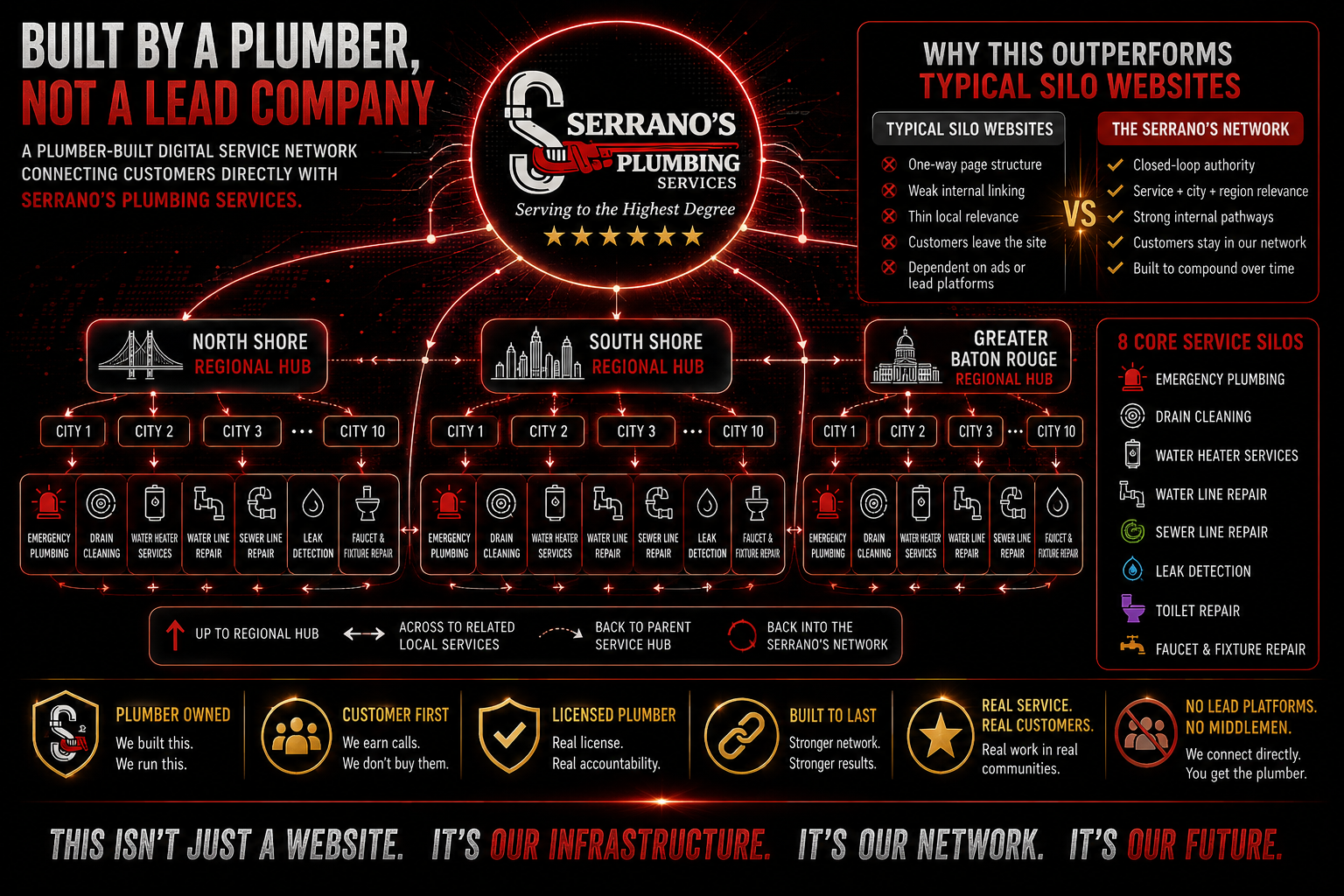
This is not just one service page and one service area page. It is a structured network built across service categories, regional coverage areas, city-level pages, and customer needs.
The exact internal linking system is part of Serrano’s operating infrastructure, but the principle is simple:
Every important page belongs to the larger network.
Every customer should have a clear path.
Every service should connect to the region and city where that customer needs help.
And no page should feel like a dead end.
The Regional Service Network
The website is organized around three major levels.
The Southeast Louisiana Level
This is the broad authority layer. It establishes the full regional footprint and connects the major service categories across the larger service area.
The Regional Level
This layer organizes service coverage across the North Shore, South Shore, and Greater Baton Rouge. Each region has its own structure, giving customers a cleaner way to understand where Serrano’s Plumbing Services works and how each area connects.
The City-Service Level
This is where local customer needs become specific. Customers do not just search for plumbing in general. They search for problems in their city, in their area, and in the moment they need help.
That is why the site is built around service pages, region pages, city pages, and local service pages that work together as one system.
The result is not a flat website.
It is a grid.
The Multi-Axis Architecture
The site is built across multiple directions at the same time.
One direction is the service path.
This includes major plumbing categories like emergency plumbing, drain cleaning, water heater services, sewer line repair, water line repair, leak detection, toilet repair, and faucet and fixture repair.
Another direction is the geographic path.
This includes the regions and cities Serrano’s serves, including North Shore, South Shore, Greater Baton Rouge, Hammond, Ponchatoula, Slidell, Covington, Mandeville, Metairie, Kenner, New Orleans, Marrero, Westwego, Baton Rouge, Denham Springs, Gonzales, Walker, and other local markets.
The third direction is customer intent.
A customer may need emergency help, a repair, a replacement, a diagnosis, or guidance before a problem gets worse. The site is designed to help customers move toward the right information without getting lost.
That is the difference between publishing pages and engineering infrastructure.
This is not a tutorial.
This is not a public blueprint.
This is the story of why the system exists.
The deeper mechanics are part of how Serrano’s operates, but the mission is clear: help customers find the real company doing the work.
The Clear-Path Navigation Standard
The site was built around a simple navigation standard:
A customer should be able to move from a broad plumbing need to the right region, city, or service page without getting lost, hitting a dead end, or being forced back to a search engine.
That matters because plumbing searches are often urgent.
A customer with a leaking water heater does not want to dig through a website. A homeowner with a sewer backup does not want to guess whether the company serves their city. A customer searching for emergency plumbing does not want to land on a vague page with no clear path forward.
The structure was built to remove that friction.
In most cases, a customer can move from the homepage into a service, region, or city pathway within just a few clicks. From there, related services, regional hubs, city pages, and service pages keep the customer inside the Serrano’s network instead of forcing them to start over.
As the network grows, the goal is not to force every path into an exact number. The goal is to keep every path clear, connected, and useful.
The site was not built only for search engines.
It was built for real people under real pressure.
Six Months of Manual Work
This was not programmatic SEO.
This was not a button that generated hundreds of pages overnight.
This was built by hand.
The internal links were placed by hand. The relationships were mapped by hand. The structure was engineered with a blueprint in my head for how the pages should interconnect.
Every page had to fit into the system.
Every city had to connect to its services.
Every service had to connect to its region.
Every region had to connect back to the larger structure.
Every related service had to support the customer’s next logical need.
That took time. It took long days. It took late nights. It took months of building, checking, correcting, and rebuilding sections until the structure worked the way it was supposed to work.
And while that was happening, the business did not stop.
I still had to answer calls.
I still had to run jobs.
I still had to find transportation.
I still had to keep the company alive.
I was not building this from the outside looking in.
I was building it while living the pressure that makes this kind of infrastructure necessary.
Taking Plumbing Back from Lead Platforms
This project has a bigger purpose than rankings.
The goal is to take plumbing search back from lead platforms and give it back to the plumbers doing the work.
A real plumbing company should not have to pay a middleman every time a customer needs help. A skilled technician should not lose opportunity because directories and lead sellers dominate the search results. Homeowners should not have to go through a platform just to find a local plumber.
Serrano’s is building a different path.
By owning the website, owning the structure, and owning the content, the company can create its own call flow. That gives the business more control. It gives customers a more direct path. It creates room to pay technicians better, invest in training, grow service capacity, and build a company that is not controlled by advertising platforms.
The Cold, Hard Math of Organic Infrastructure
If you think an independent trade company cannot out-build a multi-million dollar lead farm, look at the historical data. The shift toward independent digital asset ownership is already happening across the Gulf Coast. For instance, real-world data from Bizopia’s Houston SEO case studies tracks how a local plumbing outfit quadrupled its revenue and expanded its crew from 10 to 27 technicians simply by executing a dedicated local search strategy. Furthermore, multi-location data featured across Forthea’s digital marketing case studies proves that high-intent localized search frameworks routinely drive immense operational growth and astronomical ROI for home service franchises. When you own the network, you own the margins.
That is the business reason behind the architecture.
The website is not just a marketing asset.
It is the foundation for a better operating model.
Building for the Future of Search
This website was not built only for the way people search today.
It was built for where search is going.
Customers are no longer only clicking through ten blue links and comparing company names. They are seeing map results, AI summaries, review signals, service pages, local business profiles, photos, videos, and direct answers before they ever call a company.
That means a plumbing company cannot afford to be unclear.
Search engines and AI systems need to understand who the company is, what services it provides, where it operates, and whether the business is real enough to trust.
That is why Serrano’s Plumbing Services built more than a basic website.
We built a structured digital network.
Every service page, regional hub, city page, internal link, job photo, review signal, and supporting blog post gives search engines more context about the company. The goal is to make the structure clear enough that customers, Google, AI search tools, and future search systems can understand Serrano’s Plumbing Services as a real plumbing company serving real communities.
This is what I mean by building an AI-ready plumbing company.
Not chasing tricks.
Not depending on rented ads.
Not hoping a directory sends us the right customer.
Building a real brand, with real service pages, real local relevance, real reviews, real job proof, and a digital structure that can keep getting stronger as search changes.
Serrano’s Plumbing Services is not trying to follow the old online plumbing model.
We are building toward the next one.
A Louisiana plumbing company should be able to own its local search presence, explain its services clearly, connect customers directly to the right page, and build trust without handing control to lead sellers or platforms.
That is the standard we are working toward.
Not just ranking today.
Building something strong enough to last tomorrow.
Built to Scale Without Losing Control
This website was built with growth in mind.
Serrano’s Plumbing Services is not trying to grow randomly. The goal is to grow with structure, discipline, and control.
The website already reflects the way the company is being built: by region, by city, and by service. The North Shore has its own structure. The South Shore has its own structure. Greater Baton Rouge has its own structure. Each city plugs into the correct region, and each service plugs into the correct city.
That matters because growth without structure creates confusion.
When a company grows without a system, customers get routed poorly, service areas become unclear, technicians get stretched too thin, and the business starts depending on outside platforms to keep the phone ringing.
Serrano’s is building the opposite.
By owning the website, owning the structure, and owning the customer pathway, the company can grow into new areas without losing its foundation. New cities can be added into the existing framework. New technicians can be supported by the same service network. New service areas can be connected without rebuilding the entire business from scratch.
This is not about chasing call volume without a plan.
It is about building the infrastructure first so the company can serve customers the right way as demand grows.
A Foundation Ready to Feed Regional Technicians
The purpose of this infrastructure is not just to rank.
The purpose is to build a company strong enough to support real technicians in real regions.
Every lead that comes through Serrano’s own network is a lead the company did not have to rent from a platform. Every customer who finds us directly helps strengthen the company’s ability to reinvest into better equipment, better training, better systems, better vehicles, and better pay.
That matters.
As Serrano’s Plumbing Services grows, the plan is to reinvest heavily into the operation. The goal is not to pull everything out of the company. The goal is to build the company strong enough to feed the regions it serves.
That means building the call flow first.
Then building the technician base around that demand.
Then continuing to reinvest into the people, tools, vehicles, training, and systems needed to serve customers the right way.
The website is the foundation.
The field operation is the house being built on top of it.
A Digital Twin of the Future Service Fleet
The site mirrors how Serrano’s Plumbing Services is being built in the field.
The North Shore has its own structure.
The South Shore has its own structure.
Greater Baton Rouge has its own structure.
Each city plugs into the correct region.
Each service plugs into the correct city.
Each future expansion market can be added to the same framework without rebuilding the entire site from scratch.
That is why this site is more than a website.
It is digital plumbing infrastructure.
It is a service map.
It is a growth engine.
It is a digital twin of the company being built in the field.
Built by the Person Doing the Work
The most important part is this:
A plumber built this.
Not an agency guessing what plumbing customers need.
Not a lead company trying to capture and resell customer information.
Not a directory pretending to be the service provider.
This was built by the person who answers the phone, walks into the home, diagnoses the problem, gives the options, and stands behind the work.
That matters because the structure is based on real plumbing behavior.
Customers do not search one way. They search by problem, by service, by city, by urgency, and by trust. The site had to reflect that.
That is why the network includes broad service pages, regional service pages, city pages, city-service pages, emergency pages, water heater pages, drain pages, sewer pages, leak detection pages, and related-service pathways.
The structure is not theoretical.
It came from the field.
What This Means for the Future
The second van was not the finish line.
The 356-page website is not the finish line.
Ranking across the region is not the finish line.
This is the foundation.
The future is a plumbing company that can serve customers across multiple regions without depending on lead platforms to survive.
The future is a company that can hire technicians, train them well, pay them well, and give them steady work because the business owns its own customer pipeline.
The future is a company where the money stays closer to the customer, the company, and the people doing the work.
That is what I see when I look at this website.
I do not just see pages.
I see my family’s future.
I see future technicians feeding their families.
I see customers finding a real plumbing company directly.
I see an independent trade company proving that it can compete at a regional level without surrendering its future to someone else’s platform.
Frequently Asked Questions About the Serrano’s Plumbing Network
What does “built by a plumber, not a lead company” mean?
It means this website was built by the owner of Serrano’s Plumbing Services, not by a lead platform, directory, or outside company trying to sell customer information. The goal is to connect homeowners directly with a real plumbing company that performs the work.
Why did Serrano’s Plumbing Services build such a large website?
The site was built to create a clear service network across regions, cities, and plumbing categories. Instead of relying only on paid ads or third-party lead platforms, Serrano’s built its own infrastructure to help customers find the right plumbing service directly.
How is this different from a typical plumbing website?
Most plumbing websites only have a homepage, a few service pages, and a general service area page. Serrano’s built a structured network with service pages, regional hubs, city pages, local service pages, related-service pathways, and supporting blog content.
Why does internal linking matter?
Internal linking helps customers and search engines understand how the pages are connected. On this site, pages are connected by service, region, city, and customer need so users can move through the network without getting lost.
Why does Serrano’s Plumbing Services perform a 25-point inspection?
A 25-point inspection helps identify plumbing concerns that may be connected to the original service call. The goal is to help the customer understand the condition of the home’s plumbing system, catch potential issues early, and make informed decisions instead of only reacting to the immediate problem.
Is Serrano’s Plumbing Services still a local plumbing company?
Yes. Serrano’s Plumbing Services is a real plumbing company serving customers directly. The website is not a replacement for the field work. It is the digital infrastructure supporting the real plumbing company being built in the field.
Why is Serrano’s Plumbing Services building its own digital network?
Serrano’s is building its own network so customers can find the company directly without depending on lead platforms, directories, or rented advertising channels. Owning the customer pathway allows the company to reinvest more heavily into service, technicians, equipment, training, and long-term growth.
An Open Invitation to the Industry
Serrano’s Plumbing Services is not hiding the vision.
We invite home service marketers, SEO professionals, trade publication editors, plumbing business owners, and independent contractors to study what is possible when an independent trade company builds its own digital infrastructure.
The exact operating details are part of Serrano’s internal system, but the principle is simple:
Build real service pages.
Serve real customers.
Show real proof.
Make the customer path clear.
Stop depending on platforms that do not do the work.
This is what an independent trade contractor can build when he stops waiting for lead platforms to feed him work and starts building his own infrastructure.
This is not the final version of Serrano’s Plumbing Services.
This is the foundation.
The next chapter is about strengthening the grid, expanding the service fleet, hiring great technicians, paying them well, reinvesting heavily into the company, and proving that a plumber-built business can compete at a regional level without surrendering its future to Angi, Yelp, or any other lead-selling platform.
Built by a plumber.
Built by hand.
Built through setbacks.
Built for my children, my future technicians, and the homeowners who deserve to find the real company doing the work.
Built to take plumbing back.
To see the work behind the company, visit Our Work or contact Serrano’s Plumbing Services.